

Direct answer: Possibly—but only if your business falls within the chargeable merchant category and regularly receives UPI payments above ₹2,000. The implementation has reportedly been postponed until after Diwali, giving founders time to confirm their classification, calculate the potential cost and decide whether their current pricing can absorb it.
What happened
The government’s September framework introduced a 0.4% Merchant Discount Rate (MDR) on eligible person-to-merchant UPI transactions above ₹2,000, capped at ₹300 for transactions of ₹75,000 or more. Payments up to ₹2,000 and eligible small merchants remain exempt. The fee is payable by the merchant and cannot be passed directly to the buyer as a separate UPI charge. It was scheduled to begin on 15 October 2026. Reuters reported on 13 October that implementation had been postponed until after Diwali, with the revised date yet to be announced.
Those are the reported facts. What follows is Shikha Solutions’ interpretation for business owners.
Why SME founders should pay attention
A 0.4% charge looks small when viewed as one transaction.
On a ₹5,000 payment, it is ₹20. On a ₹50,000 payment, it is ₹200.
But founders should not evaluate the change transaction by transaction. They should calculate its monthly effect.
If an eligible business collects ₹10 lakh each month through chargeable UPI transactions, the theoretical cost at 0.4% could reach ₹4,000—before considering exemptions, caps and the actual transaction mix.
For a high-margin business, this may be manageable. For a distributor, retailer or service provider operating on a narrow contribution margin, it deserves attention.
The postponement is therefore not a reason to ignore the change. It is a preparation window.
What founders commonly misunderstand
“Every UPI payment will be charged.”
No. Person-to-person transfers remain free. Merchant transactions up to ₹2,000 are also unaffected under the announced framework, and eligible small merchants have separate protection. The government said more than 95% of merchant UPI transactions by volume fall within the ₹2,000 threshold.
“I can simply add the charge to the customer’s bill.”
The official FAQ says merchants cannot pass MDR to customers as a separate charge while accepting UPI payments. The correct response is to review overall pricing and margins—not create an unexpected “UPI fee” at checkout.
“My accountant will handle it.”
Your accountant can record the expense, but the commercial decision belongs to the business owner. You must decide whether prices still protect contribution margin, employees understand the payment policy and payment costs are reviewed monthly.
“The percentage is too small to measure.”
Small percentages become meaningful when transaction volume is high and margins are thin. A cost that is invisible in individual sales can still weaken monthly profitability.
“The postponement means the plan has been cancelled.”
The latest report says the rollout has been deferred, not withdrawn. The revised implementation date is still awaited. Follow official updates rather than assumptions circulating on WhatsApp.
The Shikha Solutions 4P Payment-Margin Check
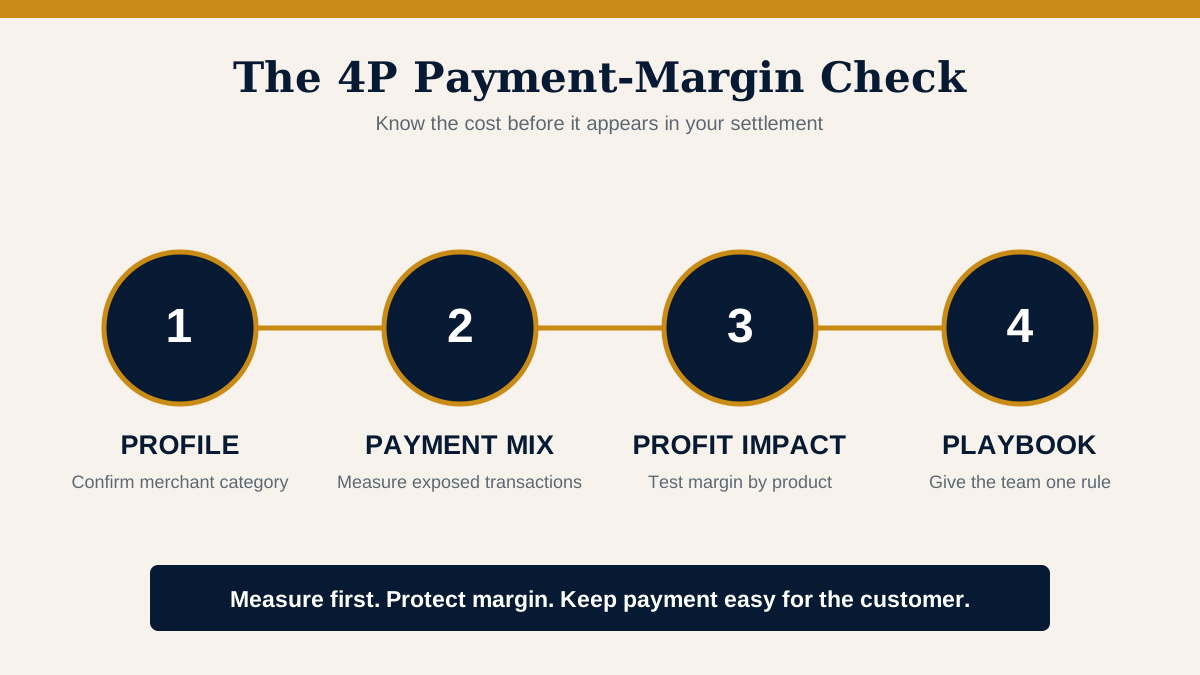
1. Profile
Confirm how your bank or payment provider has categorised the business. Do not assume that “small business” in everyday language automatically means an exempt small merchant under the payment framework. Ask for written clarification.
2. Payment mix
Review the last 30 days of collections: total UPI receipts, the number and value of payments above ₹2,000, average transaction value, UPI’s share of collections and refunds or failed payments. This shows how much revenue may actually be exposed.
3. Profit impact
Apply 0.4% to potentially chargeable transactions while considering the announced cap and relevant exemptions. Compare the result with gross profit, contribution margin, existing payment costs and discounts. Ask which products or services cannot comfortably absorb it.
4. Payment playbook
Create one clear instruction for employees: which payment options are accepted, how refunds are handled, who reviews deductions, what employees must never tell customers and when an unusual deduction should be escalated.
Founder Action: a 15-minute cost check
Open last month’s payment report and complete these five lines:
- Total UPI collections: ₹____
- Value received through transactions above ₹2,000: ₹____
- Estimated cost at 0.4% before exemptions and caps: ₹____
- Product or service with the weakest margin: ____
- Person responsible for confirming our merchant category: ____
Then ask: “If this cost starts next month, do we already know its impact—or will we discover it after money is deducted?”
If the answer is unclear, assign one person to contact the bank or payment provider and obtain written confirmation.
Final thought
Digital payments have made buying easier for customers and collections faster for businesses. That convenience still carries an operating cost—even when the customer does not see it.
Good management does not react to every announcement by immediately raising prices or discouraging digital payments. It measures the real exposure, protects the customer experience and makes a considered decision.
The implementation delay gives founders something valuable: time to prepare before the cost appears.
To identify whether payment costs, cash flow, pricing or operational ownership is the bigger weakness in your business, take Shikha Solutions’ free 15-question Business Health Check. It takes approximately three minutes. Take the Business Health Check.