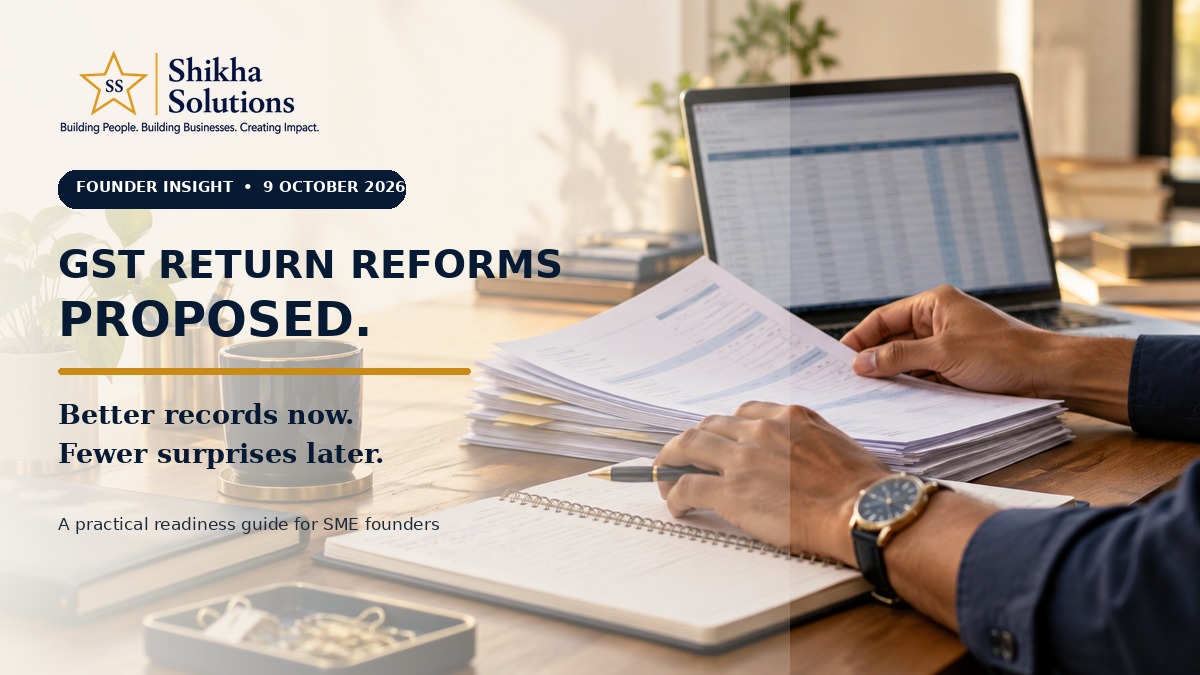
Direct answer: Start by making your sales invoices, supplier bills, credit notes, reverse-charge entries and input-tax-credit adjustments easy to trace. Give each record a clear owner, reconcile books with portal statements before filing, and keep a dated exception log. Ask your tax professional to confirm tax treatment; use this time to improve the operating process.
What happened
On 8 October 2026, the GST Council recommended changes to the return process intended to reduce mismatches between outward-supply liability and returns, and between input tax credit (ITC) claimed and portal statements. Proposals include improved alignment among GSTR-1/1A/IFF and GSTR-3B, an invoice-management mechanism for inward supplies, and electronic statements for reverse-charge entries and ITC reversals or reclaims. The Council recommended that the alternative mechanism begin with April 2027 returns and be opened for time-bound consultation. These are recommendations, not a complete set of enacted rules. Official release.
Why SME founders should pay attention
This is a systems story inside a tax update. In many SMEs, billing, purchasing, operations and accounts each hold part of the monthly record. An invoice may be corrected in one place but not another; a supplier bill or credit note may arrive after the return file is prepared.
The founder usually sees the gap late: another review, a question near filing day, or a number nobody can explain. That costs staff time and delays decisions. Software can compare data only when source records are complete, consistently categorized and owned by someone. The practical question is: does your monthly process catch missing or mismatched records before filing week?
Reuters’ report summarizes other Council outcomes; this article focuses on the return-process proposals most relevant to routine SME operations.
What founders commonly misunderstand
“Our accounting software will catch everything.”
Software can flag differences in its input. People still need to find missing invoices, unrecorded credit notes and inconsistent entries.
“The accountant owns the entire process.”
A tax professional can advise or review, but the business must provide timely records. Purchase, receiving and sales staff may hold information accounts cannot see.
“We should wait until the new rules are final.”
Wait for final rules before changing tax treatment. Meanwhile, consistent references, shared records and named exception owners help today.
“A mismatch is just an accounts issue.”
Some differences begin in sales, purchasing or dispatch. Repeated exceptions may signal a handoff gap; ask your tax professional to confirm treatment.
The Shikha Solutions 4S GST Readiness Loop
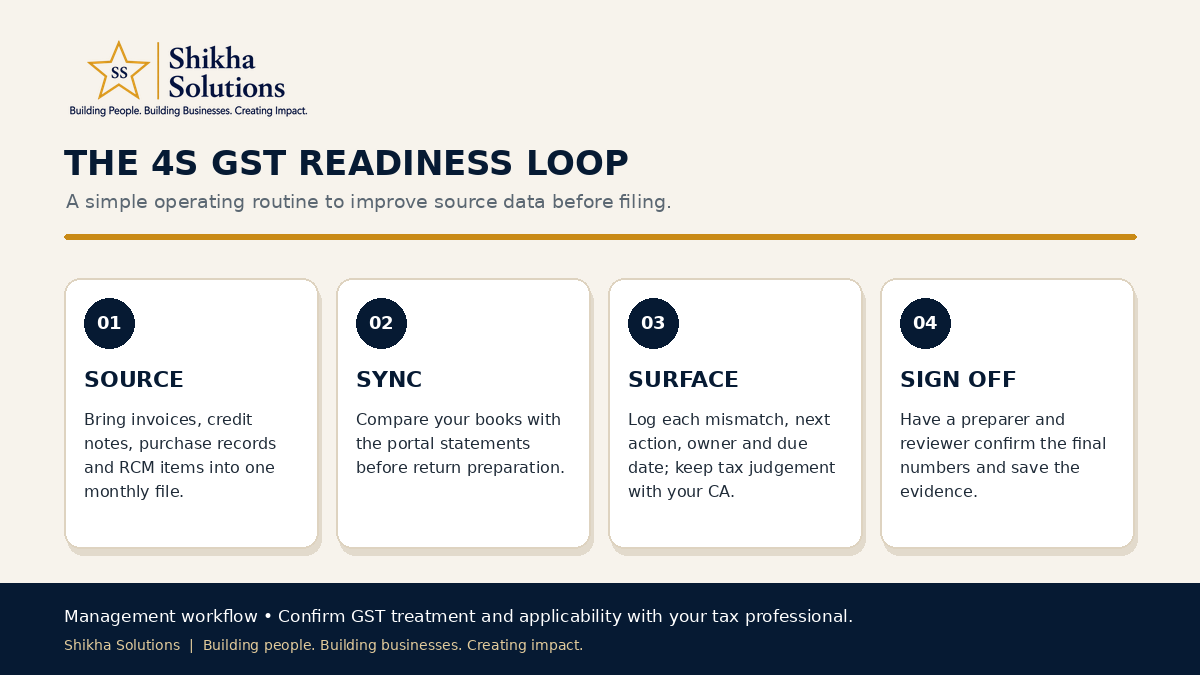
This is a management routine, not tax advice. Confirm GST treatment with your tax professional.
- Source: Keep sales invoices, supplier bills, credit notes, reverse-charge records and ITC adjustments together. Agree who submits each item and when.
- Sync: Before preparation, compare business books with relevant portal statements using the current workflow your tax professional advises.
- Surface: Log each unresolved difference, next action, named owner and due date. Escalate repeated issues to the manager for that process.
- Sign off: A preparer and reviewer confirm exceptions are resolved or explained. Save evidence and review notes together.
The goal is a dependable handoff: the team can say what is missing, who owns it and when it will be resolved without the founder reconstructing the month.
Founder Action: a 15-minute records check
Use the latest completed return period. This is a process review, not a tax calculation.
- Minutes 1–3: Find the sales register, supplier records and return working papers. Note each source owner.
- Minutes 4–7: Trace five sales invoices and five supplier bills to the monthly records. Mark missing references, late handoffs or unclear owners.
- Minutes 8–11: Check that credit notes, reverse-charge items and ITC adjustments are visible to the preparer.
- Minutes 12–15: Assign an owner and due date to each gap. Set a monthly document cut-off and review with accounts or your tax professional.
Finish this sentence: **“By the ___ of each month, ___ will reconcile , and unresolved items will go to by ___.”** Put the date in the team calendar and review whether it worked next month.
Final thought
A portal feature cannot replace clear ownership. Better records and earlier conversations across teams make compliance more predictable and reduce routine questions returning to the founder. You do not need to predict future rules; improve one monthly handoff at a time.
If you would like to identify where your business needs attention first, take Shikha Solutions’ free 15-question Business Health Check. It takes about three minutes and helps surface issues across sales, cash flow, operations, people and founder dependency. Take the Business Health Check.