
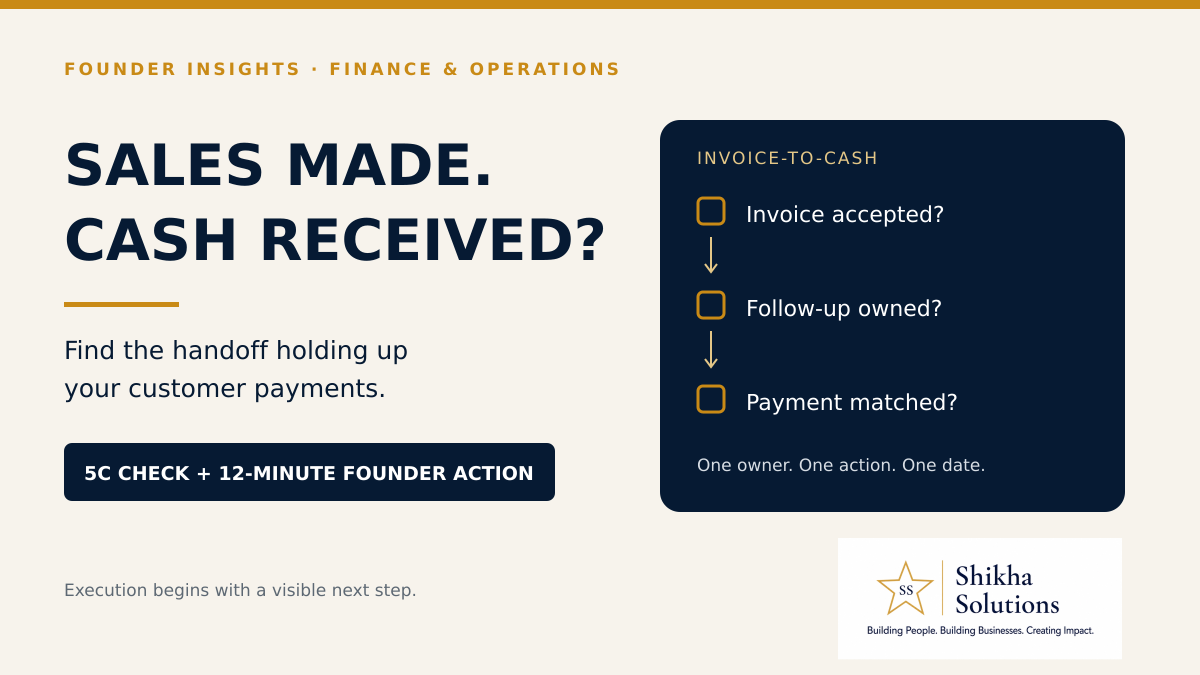
Customers may pay late because of their own cash constraints, but delays can also begin inside your business: incorrect invoices, missing acceptance, unclear follow-up or unmatched payments. Diagnose where each invoice stops before pushing harder for collections. Give every outstanding invoice an owner, a dated next action and a verified payment status.
What happened
On 11 September 2026, Bain & Company published a report developed in collaboration with NPCI Bharat BillPay. It identifies fragmented B2B workflows, manual reconciliation and disconnected invoice records as barriers to efficient payments and SME credit access. The report proposes an interoperable digital layer connecting business systems, invoices, payments and banks.
This is a proposed direction for infrastructure—not a guarantee that every SME can immediately access a new service or obtain finance. Read the Bain–NPCI Bharat BillPay report.
The diagnostic below is Shikha Solutions’ interpretation, not a framework or benchmark from the report.
Why SME founders should pay attention
A sale is a commercial achievement. Collecting and correctly recording the money is an operating process.
Between those two points, several people may touch the transaction: the salesperson confirms terms, delivery completes the work, accounts raises the invoice, the customer approves it, and somebody follows up. When these handoffs are unclear, the founder often becomes the person who remembers every promise and chases every exception.
Cash becomes harder to predict, and the founder must reconstruct what happened before anyone can act.
Before increasing sales targets, ask whether your team can answer four questions without calling you:
- Has the customer accepted the invoice and supporting documents?
- Is the payment genuinely overdue under the agreed terms?
- Who owns the next action, and when will it happen?
- Has money already arrived but not been matched to this invoice?
A larger receivables balance may reflect higher sales or agreed credit periods—not poor collections. Diagnose which invoices are overdue, disputed, blocked or unmatched.
What founders commonly misunderstand
“Accounts will handle it” is not ownership. Accounts may track balances while sales holds the customer relationship and operations holds delivery evidence. One person must coordinate the next action, even when several roles contribute.
More reminders do not solve every delay. A customer waiting for a corrected invoice or proof of delivery needs the missing information, not another generic payment message.
A payment screenshot is not reconciliation. Confirm receipt against the bank record, invoice reference and amount. Partial payments, deductions and credit notes need explicit treatment.
A new tool does not repair an undefined process. Automation can repeat an incorrect reminder faster. Establish clean records, responsibilities and exception rules before automating.
Every delay does not require founder intervention. Define boundaries for routine follow-ups and escalation for disputes or significant exposure.
The Shikha Solutions 5C Invoice-to-Cash Check
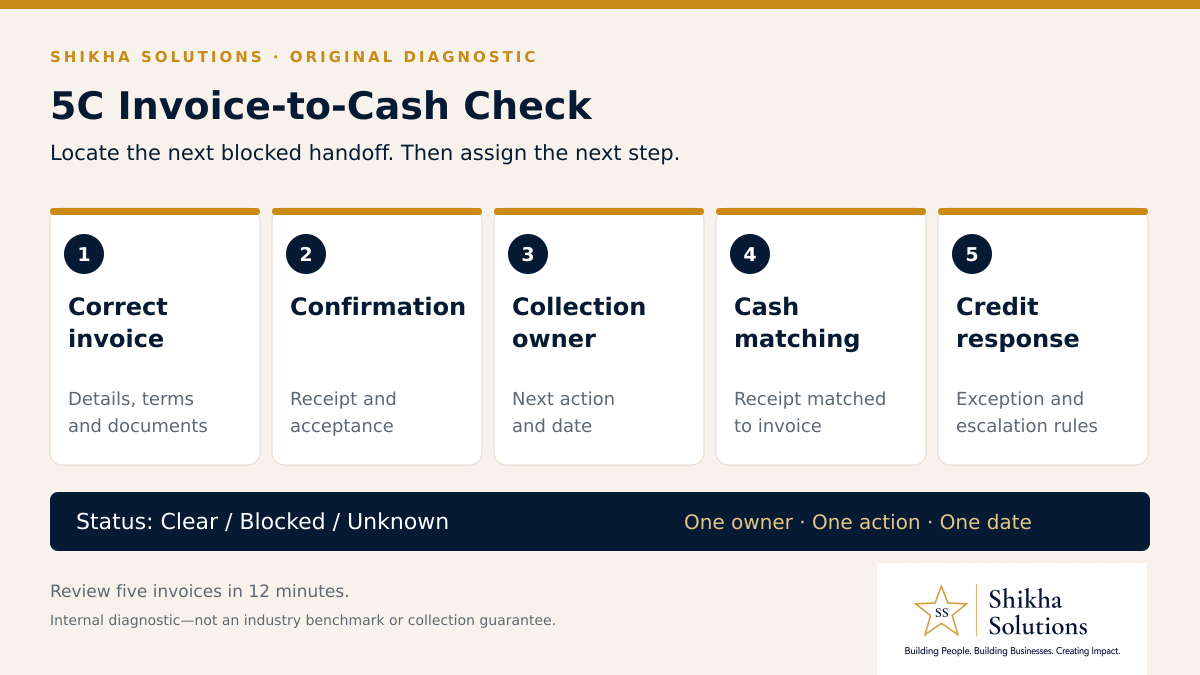
Use this original diagnostic to identify the next blocked handoff—not to label every customer a bad payer.
1. Correct invoice
Check customer details, agreed price, required purchase-order reference, payment terms and supporting documents. Record sent and due dates. Give corrections an owner and turnaround commitment.
2. Confirmation
Distinguish sending from acceptance. Confirm that the right customer contact received the invoice and that delivery or service acceptance is recorded. Identify any dispute and the evidence needed to resolve it.
3. Collection owner
Assign one coordinating owner to each outstanding invoice. Record the next action, its date, the customer’s payment commitment and any dependencies. “Follow up regularly” is too vague to review.
4. Cash matching
Match receipts to invoices. Flag unidentified receipts, short payments and deductions. Agree who checks bank records and how exceptions reach accounts or sales.
5. Credit response
Define what happens when a commitment is missed. Your response may include resolving a dispute, agreeing a payment plan or reviewing further credit under the customer contract. Set escalation boundaries; do not leave every decision to the founder. Seek qualified advice for legal recovery or financing decisions.
For each C, use a simple status: clear, blocked or unknown. This is an internal diagnostic, not a validated industry benchmark. Prioritise unknowns that prevent a reliable action, then address the most consequential blockage.
Founder Action: a 12-minute cash-handoff review
Choose five outstanding invoices, including at least one overdue invoice. Do not audit the entire ledger today.
Minutes 1–3: Write the customer, invoice amount, due date and current payment status. Verify the records; mark missing information as unknown.
Minutes 4–7: Apply the 5C Check. Locate each invoice’s next blocked handoff. Is the obstacle a correction, acceptance, follow-up, matching or credit decision?
Minutes 8–10: Assign one owner, one specific next action and one action date for every blocked invoice.
Minutes 11–12: Select one improvement to test this week. For example, require customer acceptance evidence before an invoice enters the routine reminder queue.
Review the five invoices after seven days. Track whether the blockage was resolved and whether payment was received. These are different outcomes; do not promise that process repair guarantees collection.
Final thought
Better collections begin with visibility and disciplined handoffs—not simply louder reminders.
You cannot control every customer’s cash position. You can control invoice accuracy, evidence, ownership, matching and escalation. Start with five invoices, repair one repeated gap and build a process the team can run without reconstructing everything through you.
To understand whether your wider bottleneck sits in sales, cash flow, operations, team capability or founder dependency, take Shikha Solutions’ free 15-question Business Health Check. It takes approximately three minutes and provides a structured starting point for deciding what to examine next.
Take the free Business Health Check.
Sources
- Bain & Company, in collaboration with NPCI Bharat BillPay: “India’s Next Growth Frontier: B2B Commerce, Payments, and Credit” — published 11 September 2026. Used for the reported context only. The 5C Check and Founder Action are original Shikha Solutions guidance.