
Quick answer: Treat a post-sale discount as a shared sales-and-accounts decision, not an informal promise after the invoice. Check the remaining margin, name the approver, record the commercial reason, and agree with your tax adviser on the correct credit-note treatment. Then reconcile what the customer received with what your books and GST records show.
What happened
The 26 October 2026 notification, No. 03/2026–Central Tax, brought sections 153–155 of the Finance Act, 2026 into force on 1 November. For post-supply discounts, section 153 changes section 15(3)(b) of the CGST Act: exclusion from the value of supply is linked to a supplier credit note and reversal of the attributable input tax credit by the recipient, in accordance with section 34. Section 154 adds the related discount to section 34's credit-note circumstances. These are legal conditions, not a blanket instruction to reduce tax on every discount.
Why founders should pay attention
Discounts often begin with a sensible commercial aim: close a delayed order, reward a dealer, resolve a service issue or protect a relationship. The risk appears when sales tells the customer one amount, accounts records another, and no one can show who approved the difference. The new provision makes that handoff especially important for eligible GST adjustments. It does not decide whether the discount itself was commercially wise.
Imagine an illustrative order with revenue of ₹1,000 and direct cost of ₹700, ignoring tax and overhead for this simple comparison. Its contribution before the discount is ₹300. A ₹100 discount reduces that contribution to ₹200—one-third less, even though the customer price fell by only 10%. Your own costs and contract terms will differ. The point is to approve against contribution, not just the headline sale value.
For a small business, a repeated untracked concession can also hide which products, branches or salespeople are actually profitable. If a founder must personally settle every dispute after the fact, the process cannot scale.
What founders commonly misunderstand
“The GST rule is easier, so any verbal discount is fine.” The statutory wording still specifies a credit note and the recipient's corresponding input-tax-credit reversal for the particular post-supply discount treatment. Your CA should assess the transaction and documentation before tax is adjusted.
“The salesperson can decide now; accounts can sort it out later.” That leaves the business exposed to conflicting promises and unclear margins. The commercial approval should happen before the concession is communicated, except under a defined exception route.
“A credit note proves the decision was good.” A correct document does not answer whether the discount protected enough profitable business to justify its cost. That is a management question.
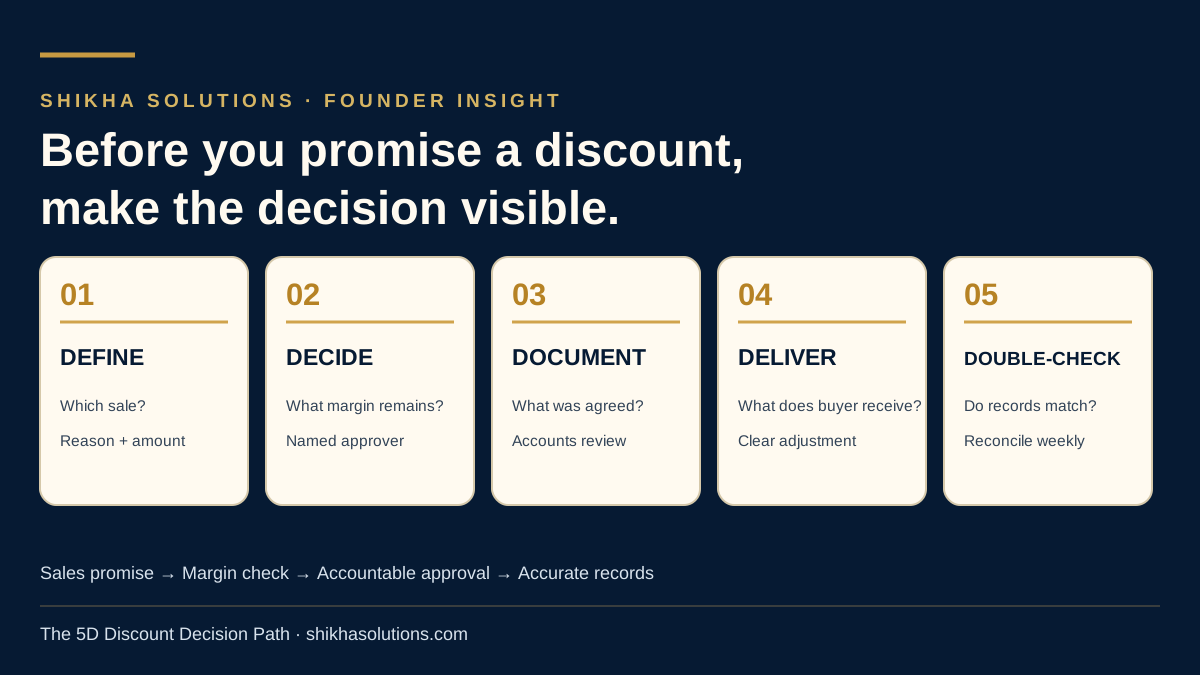
The Shikha Solutions 5D Discount Decision Path
Use five short checks whenever a customer requests a reduction after the sale. This is an operating framework, not a substitute for professional tax advice.
| Step | Owner's question | Minimum evidence |
|---|---|---|
| 1. Define | Why is the discount requested, and which sale does it affect? | Customer, invoice, reason, requested amount |
| 2. Decide | What happens to contribution and what approval limit applies? | Margin calculation and named approver |
| 3. Document | What was approved, and what treatment does accounts advise? | Approval trail and CA/accounts review |
| 4. Deliver | How and when will the customer receive the agreed adjustment? | Clear message, applicable credit note or other document |
| 5. Double-check | Do sales, ledger, customer balance and GST records agree? | Reconciliation, including recipient ITC evidence where relevant |
Set a modest approval boundary. For example, a sales manager may propose a concession but cannot confirm it until the margin threshold and approver are recorded. The threshold should reflect your business, not a percentage copied from another firm. Review exceptions weekly: repeated discounts for the same reason may point to a pricing, fulfilment or quality problem.
Founder Action: a 12-minute discount audit
Minutes 1–3: Pull your last five post-sale discounts, refunds or negotiated reductions. Write down the original invoice, reason and value for each.
Minutes 4–6: Ask who promised the amount, who approved it and whether the contribution after the concession was visible.
Minutes 7–9: Ask accounts how each adjustment was recorded and which cases need a tax-adviser review. Do not assume the same GST treatment applies to all five.
Minutes 10–12: Choose one rule for the next 30 days: an approval threshold, a single request form, or a weekly sales–accounts reconciliation. Give it an owner and a review date.
Make the next discount a clear decision
A discount can be a thoughtful way to keep a customer. It should also be visible in the business's economics and records. When sales and accounts share one approval path, the founder can see whether a concession solved a customer problem, protected a relationship or merely concealed a broken process.
If discounts are one symptom of a wider sales or execution gap, take Shikha Solutions' free 15-question, 3-minute Business Growth Score. It helps you identify where the business needs a closer look before adding more activity.
Sources and scope
- Government of India, Notification No. 03/2026–Central Tax, 26 October 2026 — commencement date.
- Finance Act, 2026, sections 153–155 — statutory amendments.
The legal facts above come from the linked government texts. The 5D framework, margin example and operating recommendations are Shikha Solutions' interpretation. This article is general business guidance, not tax or legal advice; ask your CA to review treatment for your transactions.