
Quick answer: A founder does not need venture capital to make the next growth decision. Start with the cash you already earn: convert suitable enquiries, deliver without avoidable rework and give existing customers a good reason to return. Measure each step before committing to a new branch, campaign or loan. Outside capital can help when a proven model needs it.
What happened
On 3 November 2026, YourStory Research reported $581 million of Indian startup VC investment in October, 66% below its October 2025 figure of $1.6 billion. It counted 107 deals, compared with 99 a year earlier, and attributed much of the fall in value to the absence of large rounds. Entrackr’s separately compiled tally was about $678 million, down 60.8% year on year. The datasets differ, but both describe a steep decline in funding value, especially large deals. This is a VC-market snapshot, not a measure of every small business’s access to bank credit or customers.
Why should an SME founder pay attention?
A Jaipur retailer, a coaching institute or a hospitality business usually cannot wait for a funding cycle to turn. Salaries, stock, rent and follow-ups run on cash generated now. The useful question behind the headline is: if fresh money is slower or more expensive to obtain, which part of our own growth engine can release cash first?
That question applies even to founders who never plan to raise VC. New leads require marketing effort; a new outlet needs working capital; hiring requires confidence that the work will pay for itself. Improving an existing process can make the next rupee of investment work harder. It does not mean every founder should refuse debt, equity or outside expertise. It means the use of money should follow an operating diagnosis.
What founders commonly misunderstand
“No funding means no growth.” Many owner-led businesses grow from collections and retained profit. The constraint may be unanswered enquiries or inconsistent delivery rather than a shortage of capital. Equally, a business with sound unit economics may still need working capital for inventory or a justified expansion. Do not confuse VC investment with a bank facility.
“More sales solve the cash problem.” More orders can consume cash if discounts erase margin, receivables stretch or the team repeats work. A large top line feels encouraging; collections after direct costs tell you whether you can safely reinvest.
“A founder should personally close every deal.” That can produce a good month and a fragile business. Document the first response, the next step and who owns follow-up so the team can reproduce a good sales conversation.
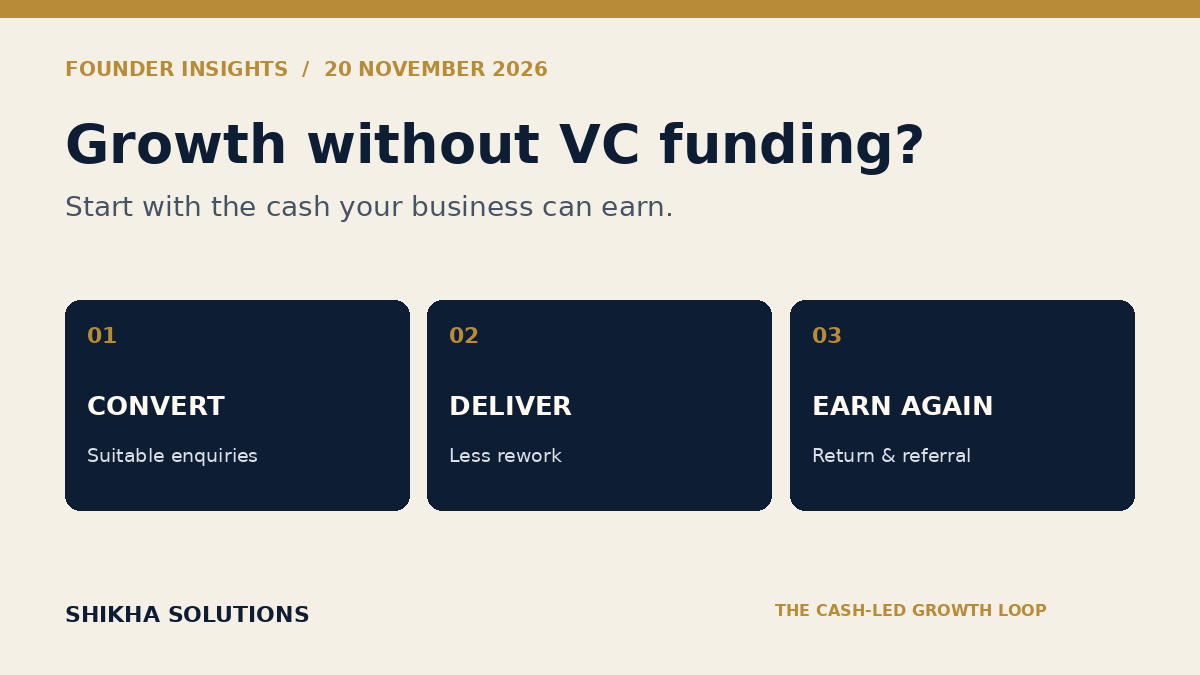
The Shikha Solutions Cash-Led Growth Loop
Review three levers in this order, using the last 30 days of actual enquiries, orders and collections. This is our practical framework, not a claim that one published funding report prescribes these steps.
1 · Convert the demand you already have
Count suitable enquiries, response times, documented next steps and orders won. Fix the handoff between marketing and sales before buying more reach. Anita Mishra, founder of Anita Steel & Solar, described our digital marketing and CRM operations support as making her work faster and more efficient. That feedback supports the value of a joined-up workflow; it does not establish a measured conversion uplift.
2 · Keep the promise with less leakage
Check late deliveries, rework, complaints and decisions waiting for the owner. Rituparna, founder of The Kosha House, described our help establishing her home-kitchen business, getting orders and creating content. That is her account of building an operating foundation, not evidence of a measured reduction in rework or an independently verified profit uplift. A clearer process can protect capacity for the next order.
3 · Earn the next purchase or referral
Identify customers whose service has ended, ask whether the outcome met their needs and decide who follows up. Track repeat orders and referrals separately from new enquiries. For a hotel, that might mean a thoughtful post-stay service check; for a coaching centre, a useful alumni relationship. These are suggested actions, not reported client results. Start with consent and genuine value, not a blanket promotional message.
The loop is enquiry → reliable experience → return or referral → cash to reinvest. Review the actual contribution margin and collection timing with your accountant. A repeat customer is valuable only if serving them remains profitable.
Founder Action: a 12-minute cash-led growth check
Minutes 0–3: Write the number of suitable enquiries, orders, repeat orders and cash collected in the last 30 days. Mark missing numbers “unknown”.
Minutes 3–6: Pick the biggest visible gap: slow response, delivery rework or no customer follow-up. Name the person responsible for that handoff.
Minutes 6–9: Choose one low-cost change for seven days: a same-day callback list, a delivery checklist or a scheduled service check after purchase.
Minutes 9–12: Record a baseline, owner and review date. Watch one measure that matters: qualified enquiries advanced, orders delivered without rework or customers who return.
Build the proof before the pitch
October’s VC numbers say something about startup financing; they do not dictate the future of a Jaipur business. The useful response is to learn where money and trust escape your existing operation. Improve that point, measure the result and then decide whether a loan, investor, new branch or bigger campaign will genuinely accelerate a repeatable model.
If you want to locate the first constraint, take the free 15-question Business Growth Score; it takes about three minutes. On 29 November, our Sur & Samvad founders’ table in Jaipur will bring 15 selected owners together to work through real business challenges and leave with a practical next step. You can also follow the Business Badhao WhatsApp Channel for ongoing ideas.
Sources
- YourStory Research, 3 November 2026 — October VC funding tally and deal count.
- Entrackr, 2 November 2026 — independent October funding tally.
Client references describe feedback shared with Shikha Solutions; the three-step framework and suggested actions are our interpretation. VC tallies are not a forecast for any individual business.