
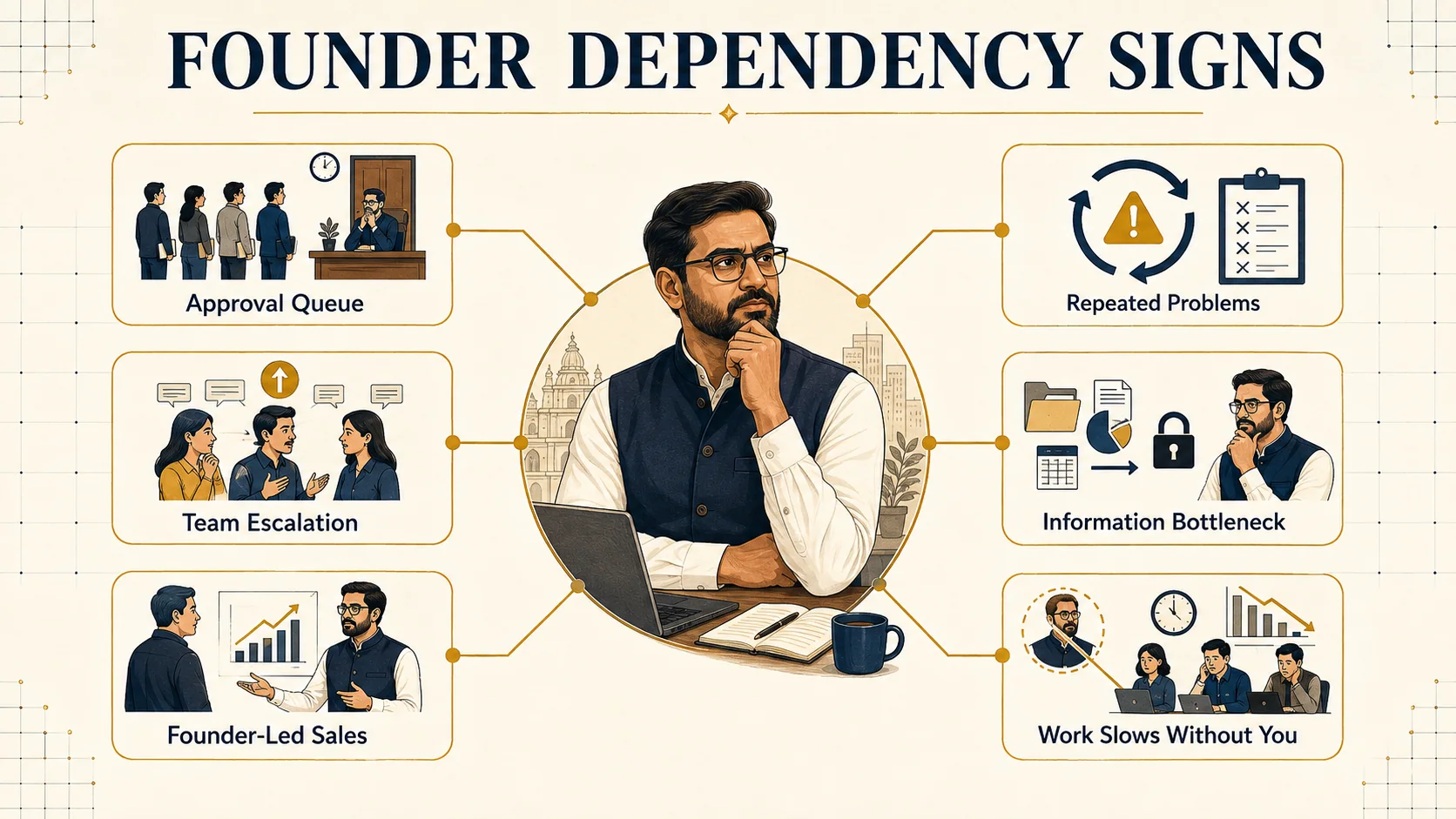
Seven signs to look for
- Routine purchases, pricing or customer exceptions wait for founder approval.
- Customers ask for the founder before accepting the team’s answer.
- Managers relay information but do not own measurable outcomes.
- The same questions return because no decision rule is written.
- Meetings end with discussion, not an owner and review date.
- Key operating data exists, but not in one trusted decision view.
- A short founder absence creates delay, escalation or hidden workarounds.
In many Indian SMEs, close relationships and founder judgment are genuine strengths. Shikha’s view is to preserve high-value judgment while transferring repeatable work. Professionalisation should not mean unnecessary hierarchy.
Diagnostic questions
- What stopped during the founder’s last three-day absence?
- Which customers, vendors and employees rely on personal access?
- Where is authority delegated verbally but reversed in practice?
- Which process has no backup owner or visible measure?
Founder Action
Run a five-day dependency audit. Log every interruption by type: decision, information, relationship, exception or reassurance. Choose the highest-frequency category and fix one cause—not every symptom.
Practical tool: dependency heatmap
Score Sales, Operations, People and Finance from 1 (team-owned) to 5 (founder-stops-work). Record one piece of evidence and one safe authority transfer for the highest score.